
Your Tags Won't Warn You Before You Run Out
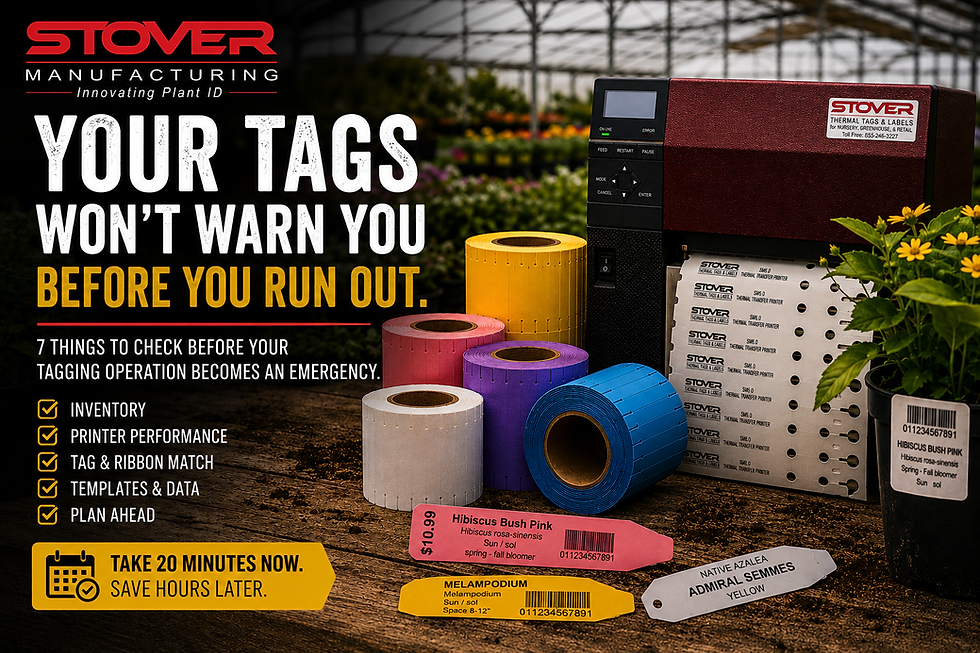
7 Things to Check Before Your Nursery Tagging Operation Becomes an Emergency
For growers, nurseries and garden centers, there never seems to be a truly "slow" season anymore.
There are busy seasons — and then there are the weeks when you're getting ready for the next one.
That's why the transition into fall is a good time to take a fresh look at something that probably doesn't get much attention when everything is working properly:
Your tagging operation.
Plant tags, labels and thermal-transfer ribbons may represent a relatively small part of your overall operation. But running out of a critical pot stake, discovering your last roll of ribbon halfway through a production run, fighting with an inconsistent thermal printer, or realizing an important label template is outdated can turn something small into a very large headache.
The funny thing about most tagging emergencies?
They aren't really surprises.
They've usually been quietly developing for a while.
So before the next rush arrives, here are seven things worth checking.
1. Stop Guessing What's on the Shelf
When was the last time somebody actually looked?
Not what the inventory sheet says. Not what everyone remembers ordering.
What's physically sitting on the shelf right now?
Take a quick inventory of the plant labeling supplies your operation depends on:
Pay particular attention to the products you simply cannot afford to run out of.
Which tag sizes move fastest?
Which materials would be difficult to substitute?
What will you need more of during the upcoming season?
Which items would immediately interrupt production if somebody grabbed the last case tomorrow?
The objective isn't to fill your warehouse with unnecessary inventory.
It's to make sure the nursery tags, plant labels and printing supplies that keep your operation moving are available when you need them.
2. Ask One Question: "What Drove Us Crazy This Year?"
This may be the most valuable exercise on the entire list.
Think back over your busy season.
What aggravated you?
Did you run out of something at exactly the wrong time?
Were employees constantly changing label formats?
Did certain tags fail to perform the way you expected?
Were different operators producing inconsistent results?
Did printing certain jobs take longer than it should?
Did your thermal printer decide that your busiest week was the perfect time to demand attention?
Or did your nursery tagging system perform exactly as expected?
If so, great.
Don't fix what isn't broken.
But if the same little problem kept appearing throughout the season, don't automatically accept another year of it. A recurring annoyance during a slower week can become a production problem during a busy one.
3. Your Thermal Printer Should Be Boring
Seriously.
A good thermal printer shouldn't be the most exciting piece of equipment in your operation.
It should quietly print what you need, when you need it.
If you've noticed changes in print quality, inconsistent feeding, unusual behavior or other performance issues, now is a much better time to investigate them than when orders are waiting to ship.
Run some of the pot stakes, wrap-around tags, adhesive labels or other materials you use regularly.
Look at the print quality.
Make sure everything feeds and prints the way you expect.
And if something doesn't seem right, ask for help.
Minor printer problems have a remarkable ability to become major printer problems at the least convenient moment possible.
Is Your Tagging System Ready for the Next Rush?
Not sure whether your printer, tags or ribbons are performing the way they should?
Stover Manufacturing specializes in thermal printing solutions for growers, nurseries and garden centers. Let us take a look at what you're doing today and help determine whether there's a better way to do it.
Don't wait until a small problem becomes a production problem.
4. Make Sure the Plant Tag Fits the Job
A plant tag isn't just a plant tag.
Where will it be used?
How long does it need to last?
What will it be exposed to?
A short-term pot stake used for identification inside a greenhouse can have very different requirements from a nursery tag expected to remain outdoors through irrigation, sunlight, handling and changing weather.
Consider:
Indoor versus outdoor use
Irrigation and moisture exposure
Sun and weather
Handling and abrasion
Expected service life
Required rigidity
How the tag will ultimately be displayed
The best choice isn't automatically the heaviest or most expensive material.
It's the material that fits the application.
Pot stakes, wrap-around tags, hang tags and adhesive plant labels each solve different identification problems.
If you've been using the same product simply because "that's what we've always used," this may be a good time to make sure it's still the best plant labeling solution for the job.
5. Your Thermal-Transfer Ribbon Matters More Than You Think
Thermal-transfer ribbon can be easy to overlook.
Until the print doesn't perform the way you need it to.
A thermal-transfer printer, ribbon and tag or label material work together as a system. The correct combination helps produce the print quality and durability required by the application.
That's particularly important when plant identification will face moisture, handling, abrasion or extended outdoor exposure.
If you're experiencing fading, inconsistent image quality or durability problems, don't automatically blame the printer.
The ribbon and media combination deserves a look too.
Good thermal-transfer printing isn't about finding one "best" ribbon.
It's about matching the ribbon to the material, printer and environment where the finished tag or label will actually be used.
6. Clean Out the Digital Junk Drawer
Not every tagging problem is sitting on a shelf.
Some are hiding on a computer.
Fall is a good time to review the information and software behind your plant tags and labels.
Take a look at your commonly used templates and databases.
Are old varieties still hanging around?
Have descriptions changed?
Are prices current?
Are barcodes printing correctly?
Are different operators using different versions of the same template?
Are there files called things like:
FINAL-Tag-Template-NEW-FINAL-v3-USE-THIS-ONE?
You know the folder we're talking about.
A little digital housekeeping now can make production much easier later.
And if your operation has grown substantially, ask a bigger question:
Is the labeling software and workflow that worked for us three years ago still the best way to operate today?
Growth can expose inefficiencies that weren't important when production volumes were smaller.
Your tagging system should be able to grow along with your business.
7. Don't Let "We're Getting Low" Become "We're Out"
This one isn't complicated.
If you have a reasonable idea of what you'll need, communicate with your suppliers before the need becomes urgent.
Review previous usage.
Consider upcoming production.
Think about seasonal changes.
Account for expected growth.
Then build a reasonable inventory plan.
At Stover Manufacturing, we work with growers, nurseries and garden centers to help anticipate tagging requirements and keep critical materials available when they're needed.
Planning ahead gives everyone options.
Waiting until the shelf is empty takes those options away.
The Best Tagging Problem Is the One You Never Have
A dependable nursery tagging operation doesn't need to be complicated.
It needs the right pieces working together:
The right thermal printer.
The right plant tag or label.
The right thermal-transfer ribbon.
The right information and software.
And enough inventory to keep production moving.
When those pieces work together, plant labeling becomes what it should be — a quiet, dependable part of your operation instead of another problem competing for your attention.
So take 20 minutes this fall and look at your system.
What's working?
What isn't?
What caused unnecessary frustration during your last busy season?
And what could you fix today that your future self will be very glad you handled?
We're Here When You Need Us
If you'd like another set of eyes on your tagging operation, talk with the team at Stover Manufacturing.
Whether you're evaluating nursery tags, pot stakes, wrap-around tags, adhesive labels, thermal-transfer ribbons, printers, software or inventory planning — or simply wondering whether there's a better way to accomplish what you're doing today — we're happy to have the conversation.
Sometimes ten minutes of planning can prevent ten hours of headaches.
Here's to a productive fall — and an even better season ahead.


Comments